Scaling Customer Success by Directing Agents

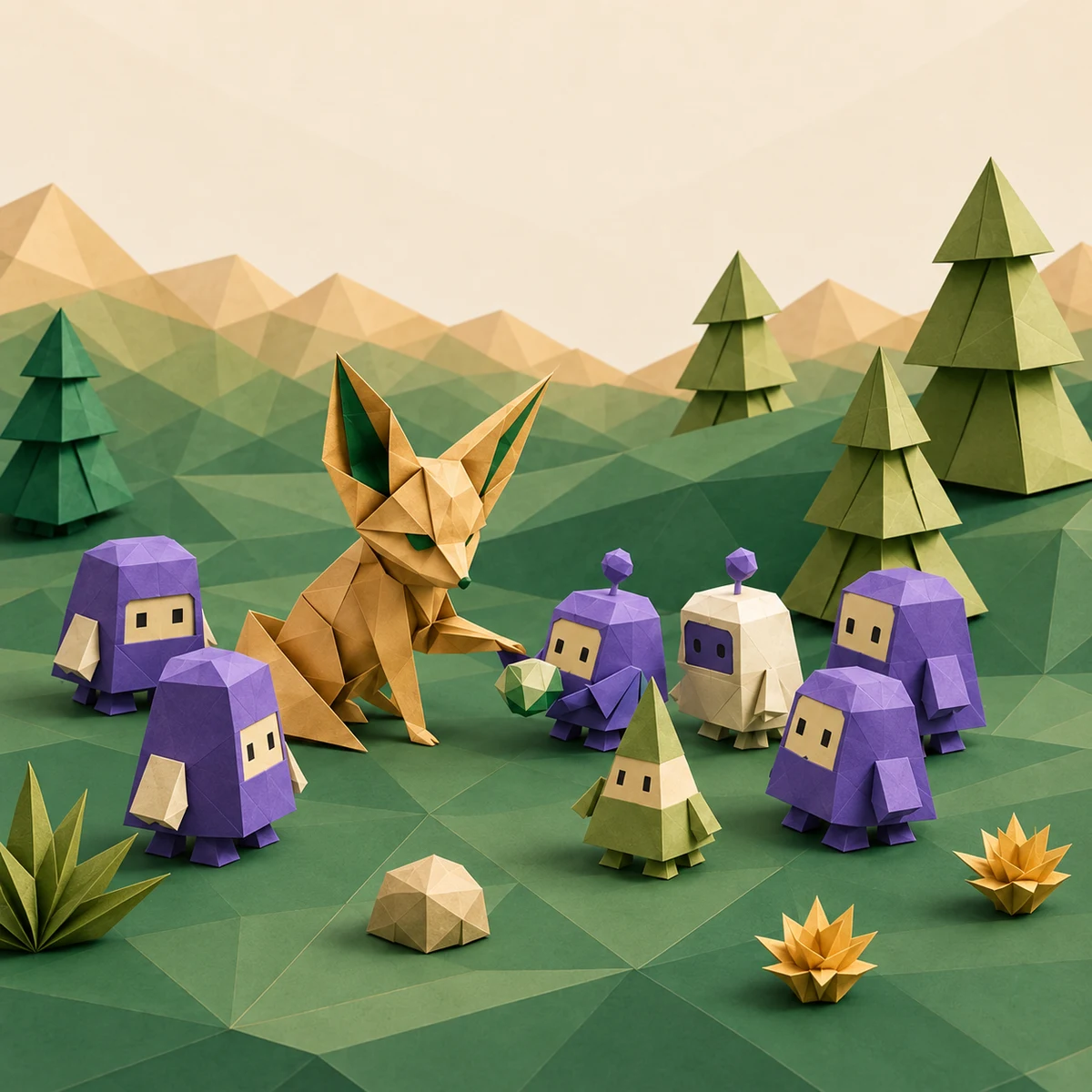
The idea is simple to say and genuinely hard to live: humans direct, agents execute. People keep the relationships, the judgment, and the revenue calls, which is the work most of us got into Customer Success to do in the first place. Agents run the repeatable work across every account, every day. Coverage stops being a hiring equation. Across teams operating this way, we’re seeing revenue per CSM roughly double on the same headcount, while proactive touch moves from a quarterly QBR to every month, on every account. You scale the outcomes without scaling the spend.
A handful of teams are already operating this way today. But you cannot get there by bolting another report or churn score onto the stack you already have. For years, watching a SpaceX launch meant watching something expensive explode. Then the rockets started sticking their landings, and eventually a returning booster flew back to the launch tower and was caught clean out of the sky by two giant mechanical arms. The mission hadn’t fundamentally changed. The engine underneath it had.
Customer Success software is having the same kind of moment. For the last decade, software could tell you what was happening: organize the book, surface a health score, flag an account at risk. But when something needed to happen, a human still had to do the work. So covering more accounts meant hiring more people. That constraint is finally disappearing. Software is moving from describing the work to doing the work, and once the engine changes, the way you scale a CS organization changes with it.
Three engines, quickly
The short version of how we got here:
- Gen 1 was a spreadsheet behind a login. Call them what they are: the legacy CSPs are an Oracle database wrapped in a dated UI, a system of record that only records what a human remembers to type into it. They promised a single source of truth and delivered one only if a sales person or a CSM entered it by hand, so your most valuable people spent their week on data entry instead of customers.
- Gen 2 bolted a model onto that same messy data and produced a churn score. But “67% likely to churn” tells you a fire exists without the cause, the account, or what to do about it this afternoon. Retrained once a quarter, it never saw the problems that emerged today.
- Gen 3 is a different engine: a customer knowledge graph. Agents read the unstructured reality of each account, the emails, calls, tickets, usage, and Slack threads, and keep a living, structured map of every relationship current. The data entry disappears, and the output gets specific enough to act on. (Here is what we actually built.)
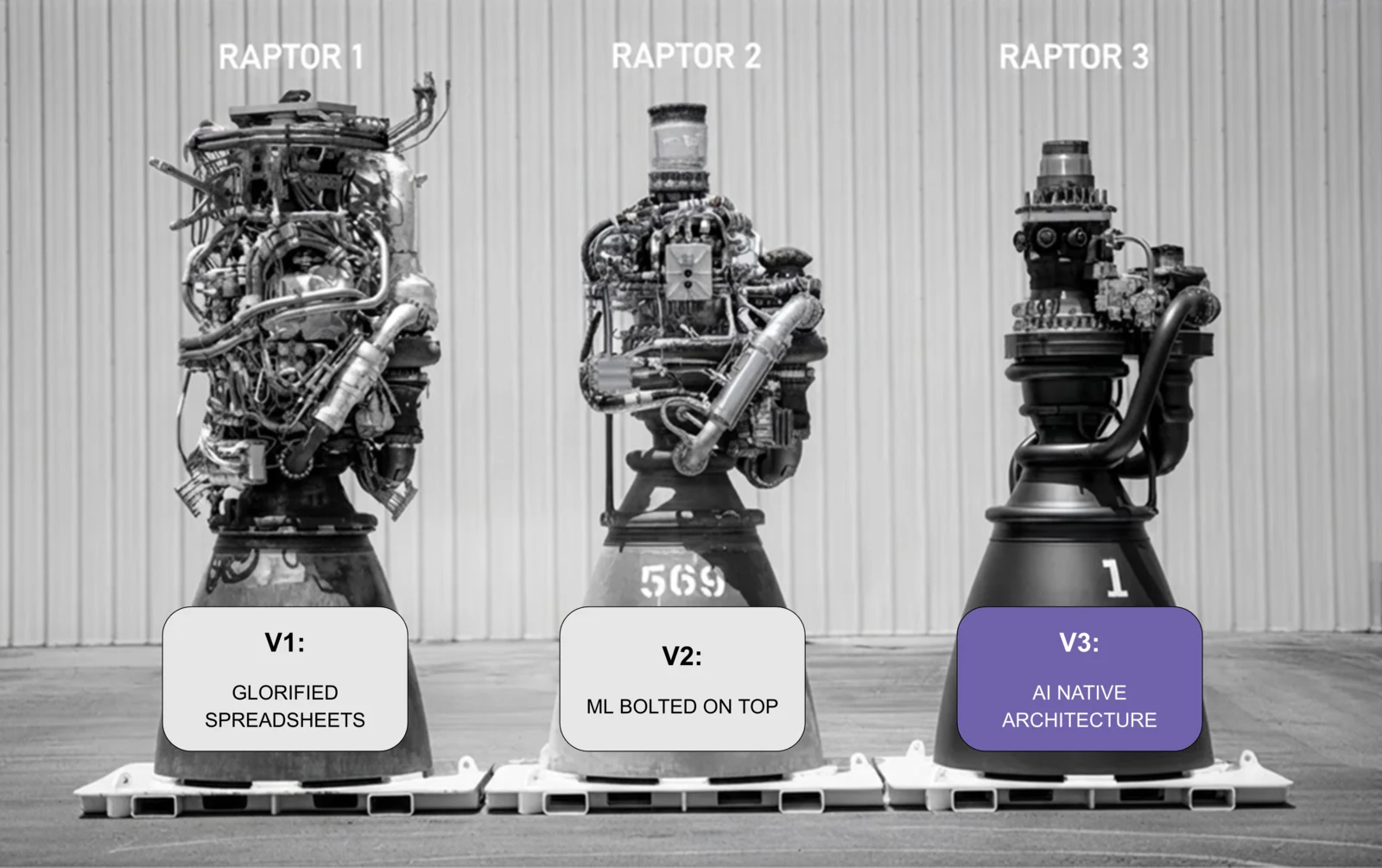
The takeaway: you cannot scale a team on an engine you have to constantly evolve. Gen 3 is the first one you can actually hand the work to, though that does not mean you stop iterating toward Gen 4 and beyond.
Two motions on every account
Once the engine is trustworthy, the way you grow changes. You stop hiring every time the book gets bigger and start directing agents to do the repeatable work on every account. We think of it as two motions on every account, across the whole lifecycle. Proactive agents that drive outcomes forward, and reactive agents that catch risk the moment it appears.
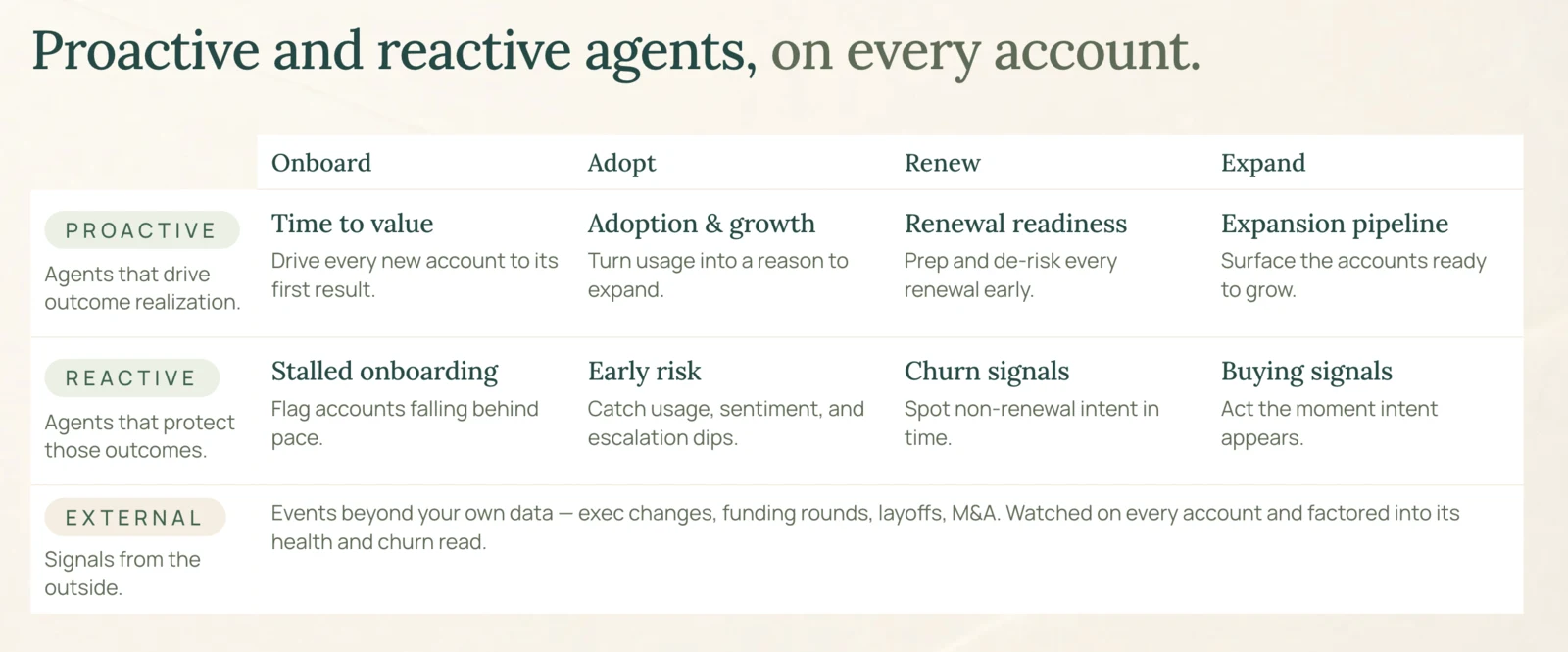
No agent works alone, and that is the point. A usage dip in the Adopt stage can trip the renewal play a full quarter early, so the team runs a save motion instead of a scramble. A champion leaves a key account, and the moment the signal lands, the account is re-qualified and its new stakeholders are mapped that same day. That only works when every agent reads from the same engine. We call that engine the customer knowledge graph. You can see the full roster on the agents page.
The rise of the CX Engineer
The teams getting the most out of this did not just buy software and keep working the old way. They redesigned how the organization runs. A sharp operator, very often promoted out of RevOps, steps into a new role: the CX Engineer, who directs agents across every segment the way a manager once directed people.
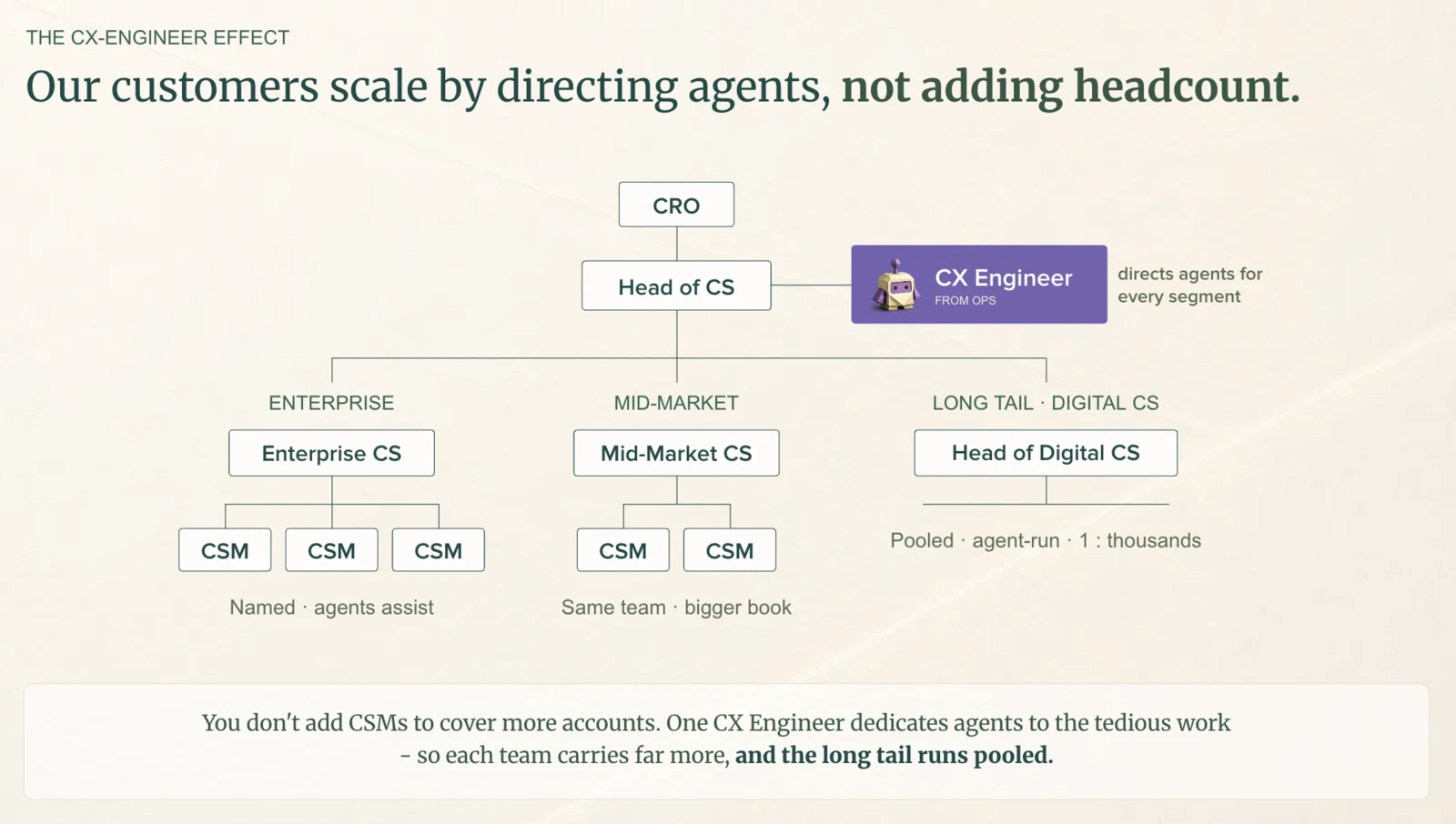
Here is how the org actually changes:
- Enterprise keeps its named CSMs, the people who own the relationships and the hard calls. Agents quietly handle the administrative work underneath them.
- Mid-Market keeps the same team, but each person carries a much bigger book without burning out.
- The long tail stops being the neglected sibling of your book. For years, “digital customer success” was a polite word for less: less attention, less personalization, a batch of templated emails for the accounts too small to earn a human. That flips. The long tail runs pooled and agent-first, at one to thousands, and each customer gets guidance shaped to their situation instead of a one-size-fits-all cadence.
That is what humans direct, agents execute means in practice.
The engine is finally here
The rockets stopped exploding once the engine underneath them was reliable enough to trust. Customer Success is at that same point now. The engine is finally here, and the teams that build on it will scale in a way that adding headcount never could.
Companies like MuleSoft, Rocketlane, and Ivo have already upgraded their stack, and they are doing more with less. Ocrolus handed 184 hours a week back to its team — four hours for every person on the platform — and that is what doing more with less looks like in practice.
Anton spent 15+ years building products at MuleSoft, Salesforce, and Carta, watching CS teams scale by adding headcount. He started Sonora to give every account concierge-level coverage with proactive and reactive agents that drive customer outcomes.
Subscribe to our mailing list to receive new stories
Subscribe to our mailing list to receive new stories directly to your inbox.