Your CSP Forgets Your Customers. Yet Your AI Remembers You?

The first time you used Claude, it was a stranger. Every conversation started from zero. Then it got memory. Now it knows your voice, your projects, that you want the answer before the caveats. The intelligence barely changed. The memory did, and it turned a tool you operate into a colleague who’s been paying attention.
Here’s the uncomfortable part: your AI now remembers you better than your customer success platform remembers your customers. Your CSP has every record of them and no memory of what any of it meant, or exactly where it came from.
The most expensive amnesia in software
Your CSP holds a close date, a renewal date, a contact with a title that was accurate two promotions ago, and a health score that’s green.
Your best CSM holds something else entirely: that the champion who drove the deal got a new VP six weeks ago and has gone quiet, that the “green” account gave up filing tickets and then its product usage suddenly stopped, that someone asked for SSO in March and should be the first call when it ships.
None of that lives in the system. It lives in a person. When that person takes another job, the memory leaves with them and the account resets to a stranger. It’s not a lack of data, it’s a lack of memory: the data sits in five tools that don’t talk, and the meaning evaporates the moment someone walks out the door.
The CSP is dead. It just doesn’t know it yet.
The customer success platform is a product of its era. Ten years ago, the best software could do with customer data was collect it, normalize it, and render it as a number on a dashboard. So Gainsight, and everything built in its image, is a database with a reporting layer and a health-score formula you configure in a UI. The data goes in. Your team does the thinking.
That was reasonable in a world where software couldn’t read. It can now. The moment a system can read a call, weigh a support thread, notice a champion went quiet, and connect it to yesterday’s layoff, the dashboard stops being the product. The reasoning is the product, and reasoning is hard to retrofit onto a platform whose entire foundation assumes a human will supply it. The category isn’t fading because it’s bad software. It’s fading because the assumption underneath it, that the software stores and the human understands, is no longer true.
Memory isn’t a bigger database. It’s a record of what things meant.
The old fix was more storage: log every call, sync every ticket, pile it into a warehouse. A decade of that produced a bigger pile nobody reads, not memory. The newer fix is to point AI at the pile through MCP. That works for a single account, but you’re still aiming intelligence at raw data one query at a time, re-reading everything from scratch on every run. A smart stranger reading your files each morning, not a memory.
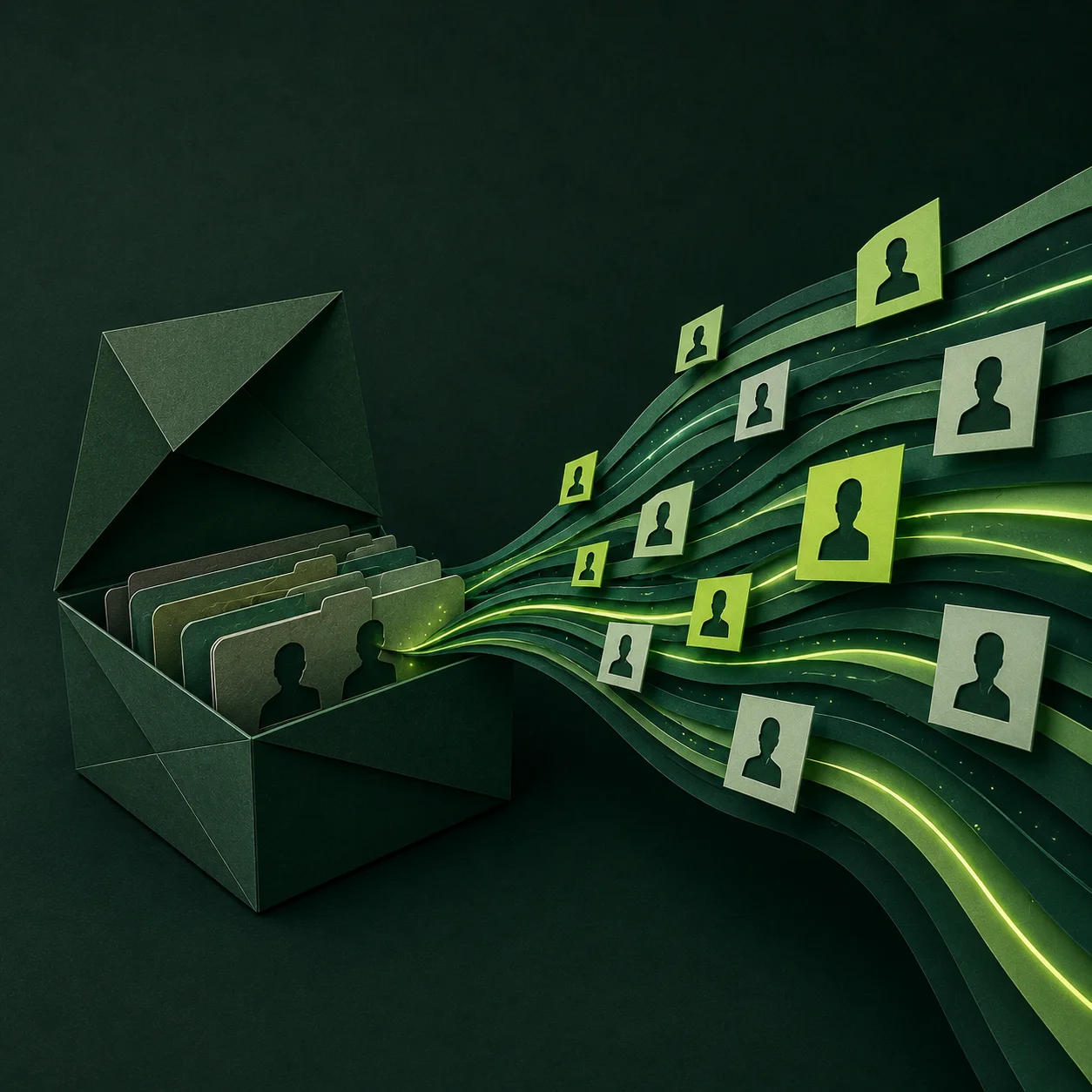
Memory knows what happened and what it meant: not “meeting logged March 4,” but “the economic buyer ruled out the status quo in her own words, so this deal is real now.” That’s a leap of structure. Sonora tags and types every interaction (tickets, calls, emails, Slack, usage, external signals) into a single connected graph before any agent touches it, with the meaning attached: health, escalation risk, champion status, expansion readiness, exec changes. We call it the Customer Knowledge Graph.
What Sonora remembers
Sonora runs an agent on every account, every day, reading everything connected plus what’s happening outside the account on the open web. Because those agents query the graph instead of raw exports, the same intelligence that works on fifty accounts works on five thousand. A few of the things it never forgets:
Who your champions are, and the day they stop being one. When a champion changes their LinkedIn to a new company, Sonora flags it that week and re-reads the account knowing your strongest advocate is gone. Most teams find out at the renewal, when it’s already a fire drill.
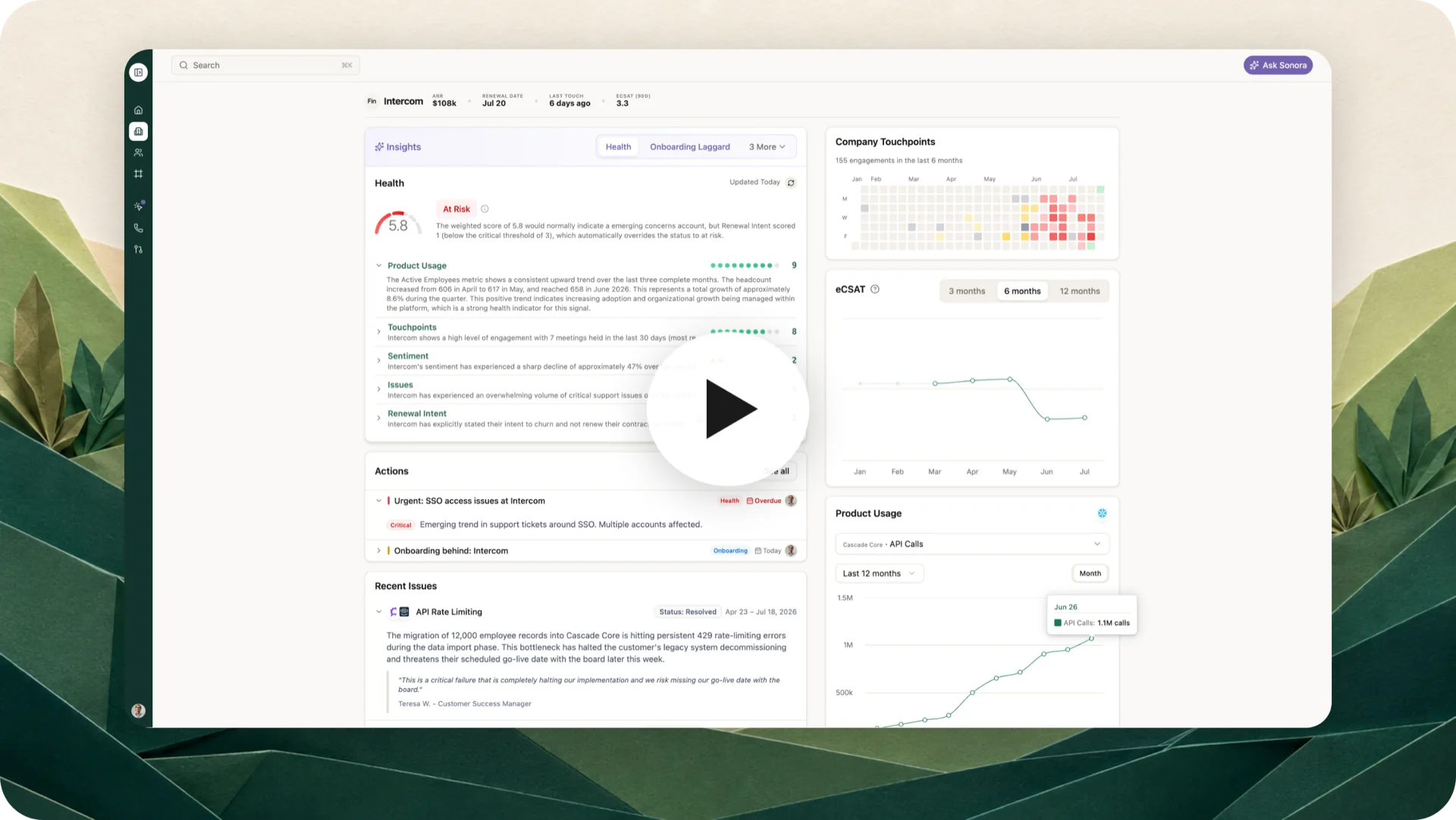
When the mood turns, before the number does. Sentiment is a trend, not a label. Sonora compares the last 45 days to the prior 45 and tells you whether an account is improving, stable, or sliding, while the health score still reads green.
Every unresolved thing, and how long it’s been open. The CFO cc’d on three tickets about the same payroll sync, open 18 days. The feature asked for 90 days ago, still in the backlog. Humans forget the third ticket. Memory doesn’t.
What’s happening in the customer’s world. A funding round, a layoff, a CFO leaving. That context usually gets read in the news and lost. Here it feeds the same memory, so a risk read can weigh the exec who just left, not only ticket volume.
One signal is noise. A departed sponsor, plus a layoff, plus sliding sentiment, plus usage dropping on the core module — read together, that’s a memory telling you sixty days early which account is about to churn, and why.
It gets sharper the longer you keep it
At month one, you have a smart read on every account. At month twelve, you have a complete, explainable record of your entire book, every conclusion traceable to the call, ticket, or email behind it. When your best CSM leaves, the next person inherits twelve months of understanding instead of a spreadsheet of dates. Tribal knowledge that used to walk out the door becomes an asset that compounds for the whole company.
The relationship was always the product
We spent a generation building software that stored more about customers than ever and ended up knowing them less. The shift that turned your assistant from a stranger into a colleague is the one that turns a book of accounts into relationships a company can hold onto.
Your customers already remember you: the ticket that took three weeks, the QBR where you clearly hadn’t read the account. The only question is whether your side remembers them just as well.
Partner with us
Sonora exists for one purpose: to give post-sales teams a real memory of every customer they serve. We’re grateful to the teams who took a leap of faith to build this platform with us, and we’d love to bring what we’ve seen at companies like Merge, Ivo, and Ocrolus to your customers too.
If you’d like to learn more, book a demo → and see what your book of business looks like with a memory.
Anton & Paul
Subscribe to our mailing list to receive new stories
Subscribe to our mailing list to receive new stories directly to your inbox.